Friday, 25 March 2011

Wow! Unmanned...


ABB Crane Systems has begun commercial production of the world’s first unmanned ship-to-shore crane system after developing the technology in close co-operation with Manzanillo International Terminal (MIT) in Panama.

The remote operation was developed with MIT (pictured), which had a team of engineers and operators to test and evaluate the functionality.


ABB said that the unmanned STS crane was realised as a logical step in the company’s extensive range of automation solutions for STS and stacking cranes.

As Cargo Systems reported in December 2007, the partners initially developed a system which fixed the operator’s cabin to one of the waterside legs of the STS crane. That step has now led on to a fully remote operation.

According to ABB, the unmanned STS crane is “an excellent example of how one market segment can benefit from progress made in another segment”.

The firm explained that the unmanned operation was one important step in a series of development projects targeting STS crane productivity, energy efficiency and driver ergonomics.

Instead of sitting in the cabin attached to the trolley, the crane operator can now supervise the operation from a remote control station similar to that used for automatic stacking cranes (ASCs).

The development is expeted to means a greatly improved working environment for the crane operator without imposing stresses on his back.

“We are pleased to see the new unmanned operation in production and are proud to be the first in the world to deliver the system,” said ABB.

Courtesy: www.cargosystems.net

Thursday, 24 March 2011

ROADTRIP: Jamshedpur-Ludhaina-6

In the excitement of having escaped from paying any bribe at the Bihar entry point, we have totally forgotten about our lunch on Day 2.

We passed the second toll gate at Sawkala after paying Rs.210 as fee around 2.30 p.m. The traffic flow was normal - noticed several tarpaulined trucks of DARCL (earlier known as Delhi Assam Road Carriers) in the opposite direction.
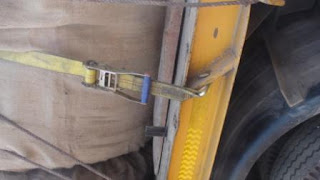
But in per centage terms, the car carriers was very high with OSL dominating the scenario.

Close to 5 p.m., we slipped through toll gate 3 at Sasaram (Rs.165). Earlier in the day, we crossed Gaya, 65 km before Sasaram. Three days ago, I had passed through these landmarks in a train from Delhi.

Benares or Varanasi, I was told, would come about in another 100 km. What are the chances of witnessing the sacred city in daylight? No chance, said Pandeyji. It would be dark because Benares is in Uttar Pradesh and the chances of being "waylaid" by RTOs and Traffic Inspectors are considered very high.

By dark, we exited Bihar and entered Uttar Pradesh. Perhaps the shortest duration we had spent on Bihar soil. The Uttar Pradesh stretch would be a long one, I heard Pervez telling no one in particular.

In a few kilometres, we would be moving away from the pucca 4-lane NH2 and move into state highway which according to Pandeyji was nothing to write home about. I was feeling a bit low.

Quietly our trailer moved away from NH2 and entered a service lane in utter darkness. We got out and Pandeyji led us to the makeshift hut where we were greeted with "namaste". Pandeyji handed over the truck papers to the young lad who for a fee would get the entry permit.

All commercial vehicles have to fill up a form, solemnly affirm that the goods being carried are not for sale in Uttar Pradesh and thereby need not pay commercial tax levied by the state government. Besides, the fleet driver/company has to indicate his route plan as he plans to traverse through Uttar Pradesh and specifically state which paprticular border checkpost he would use to exit Uttar Pradesh.

Usually, the drivers get a 4-day permit given the fact that our truck has to reach Punjab through Haryana. The young lad, who is well versed in these matters swiftly filled in the forms on his own, exited. While waiting for his return, we entertained ourselves with a hot cuppa tea brought in by his assistant.

The hut had a long wooden cut and two hurricane lamps,burning brightly. Mosquites buzzed feverishly around my ears. Remembered that I should have carried Odomos, the mosquito repellant, which my spouse had packed into my bag when I left Delhi. It ought to be in the bag, I told myself.

Soon, the young lad reappeared and handed over the paper with the offical "chappa". He grandly announced that we got 4 days to exit Uttar Pradesh. Do we really need 4 days? I asked Pandeyji.

Two and half a days is more than sufficient. But, who knows. If there is a hartal or road blockade due to any reason, we would be stuck on the highways. It is a precautionary measure. What if, still we are unable to exit within the prescribed 4 days time limit? "Then, we have to seek fresh permission for additional day and give reasons for delay," he explained.

After compensating the young lad, Pandeyji enquired about "road vultures" en route. He was told "nothign to worry" because RTOs don't roam in the nights in UP. Maybe, we may bump into Traffic Inspectors.

But as luck would have it, within 30 minutes, a commercial tax jeep halted us in the middle of the road. Pandeyji jumped out with relevant papers and after scrutiny, we were permitted to proceed. "We were clean," boasted he.

We crossed Benares toll gate (fourth since we entered NH2) after paying Rs.165 as fee. We began to see the din and bustle of Benares from the distance around 8 p.m.

Once again, hunger pangs began. All of us were hungry no doubt. Unfortunately, I could not even sight the sacred Ganges from a moving vehicle.

Suddenly, there was a call to Pandeyji and the caller was the 'young lad'. He hinted that we would have to meet a traffic inspector before we exit NH2 into NH56 which connects Benares with Lucknow where we are headed.

Every few minutes, Pandeyji was getting calls on the possible whereabouts of the prospective bribe-taker!

Nothing happened. No vulture sprang and we moved into NH 56. Bloody, the name is National Highway. But it was like NH33 - two lanes through villages and towns.

Around 9.30 p.m. I think Pandeyji also felt hungry and decided to halt at Dhaniamou, 25 kms before Jaunpur. It was pitch dark.

We got out after parking the trailer on the roadside - leaving sufficient room for both way traffic to proceed unhindered! A mammoth task, indeed.

We sat down for "dinner" in an unlit dhaba where half a dozen other drivers were already eagerly gobbling up their food.

We settled for tandoori roti, dal, salad and dahi.

It was very cold. For the second night, I tucked into the lower berth, borrowed an extra blanket from Pervez and dived into deep sleep.

Pandeyji causually indicated that we had covered 754 km since leaving Jamshedpur the previous day.

Another 900 km to cover. Uff.

(To be continued)

Wednesday, 23 March 2011

India, booming infra market: Lord Green


India’s booming infrastructure sector offers opportunities for UK firms

As India plans to spend US$1 trillion on infrastructure development over the next five years, the UK's Minister for Trade & Investment Lord Green was in Delhi last week, with a UK rail mission, helping British companies to seek out new business opportunities.

India's busiest railway stations already handle more passengers than the combined numbers handled by all of the country's airports. India plans to spend £57 billion developing its rail network into world-class facilities across the country.

Lord Green believes that UK companies can offer their expertise and capabilities to help India transform its infrastructure capacity, which is key to driving forward its future economic growth.

Last July, the UK and Indian Prime Ministers established the Britain-India Infrastructure Group (BIIG) to take forward business interests in India's large scale infrastructure development program.


British companies including Mott MacDonald and Halcrow are already closely involved with the Delhi Metro project, and a number of other metro projects across India.

India US$1 trillion infrastructure development plans include:

* £6 billion for the construction of dedicated freight corridors along the eastern and western sides of the country.

* £57 billion on rail development, including £1.95 billion for the Chennai Metro Project and £1.5 billion for the Hyderabad Metro.

* Other metro projects include the Delhi metro expansion, Bangalore Metro and the Kolkata Metro.

* India plans to develop six high speed rail corridors including:

•Delhi - Chandigarh - Amritsar
•Pune - Mumbai - Ahmedabad
•Hyderabad - Dornakal - Vijayawada - Chennai
•Howrah - Haldia
•Chennai - Bangalore - Coimbatore - Ernakulam
•Delhi - Agra - Lucknow - Varanasi - Patna

Lord Green has also called for greater economic liberalisation in India to further the enhanced partnership between India and the UK, saying that a successful EU-India Free Trade Agreement in the coming months, as well as completion of Doha negotiations, would benefit both British and Indian companies.

India-UK trade rose by more than two-thirds between 2004 and 2009 and now stands at more than £11 billion a year.

Bilateral trade in 2009 was £11.5 billion. The UK's exports to India increased by 37% last year, while India's exports to the UK increased by 17%.

India is a leading investor in the UK, where more than 700 Indian companies are operating, and the UK receives more than 50% of India's investment into Europe.

ROADTRIP: Jamshedpur-Ludhiana-5


Bathing, I found, is a luxury when you are travelling on a truck over 1650 km on Indian highways.

I mean the closed door bathing which most of us are used to in our daily life.

During my November 2010 Chennai-Gurgaon (2800 km) trip over 7/8 days, I had the chance to bath twice. Luckily the weather was fine then - the onset of winter even in the sultry southern states.

This time, the weather was equally supine because it was still mid-February and I was travelling in the eastern and northern India.

Around 12 noon, we exited Jharkhand through the first private toll station at Raso Dhanolti near Barhi and entered NH 2. Wow! It was a great relief to see a pucca national highway.

How long this luxury would last? I asked Pandeyji.

Till we cross Benares - maybe 250 km - after sunset. By then, we would have exited Bihar also.

Hardly 15 minutes after crossed Barhi toll gate, our trailer came to a halt at a secluded and solitary dhaba.
There were two more Credence Logistics trailers already parked and saw a few drivers lying on the coir cot under the thatched roof.

Pandeyji exchanged greetings with them.

"Now is the time for bath," announced Pandeyji proudly.

We ejected out of the horse and I looked around. Well, there was a 8 x 4 feet water tank and a hose pipe was connected to a nearby well. The tank was filled to the brim. There was none around that place except us. On the near tree, some wet clothes were hung out he clothesline for drying.

With a set of changing clothes, I approached the tank and dipped my fingers into it. It was ice cold.

"You'll enjoy, sirji," cooed Pervez.

Cool wind. Warm sunshine. Cold water. It was blissful.

Next 30 minutes flew away in relishing this open air bath.
Incidentally the dhaba belonged to an ex-employee of Credence Logistics who saw a future in running the dhaba instead of "drivery". Well, that is the word I kept hearing from drivers when they talk about their profession. The second driver or assistant calls him pursuing "conductory". The dhaba owner also acts an external outsourced assistance in helping Credence drivers in managing Bihar highway authorities.

Back in the saddle, all Credence Logistics vehicles drove in unison with the dhaba owner's assistance hitchhiking in one of them towards actual entry into Bihar. After you exit the Barhi tollgate, one is almost in no-man's land. But the roads are fine.

Drivers in opposite direction were signalling that there were no RTOs or Traffic Inspectors on the road. What happened next?

“Are you mad? Stop flashing that currency note in my face. They are watching,” shouted the officer at the Jharkhand-Bihar checkpost on National Highway 2. The young truck driver moving out of Bihar was baffled. Again, he was thrusting the currency note into the hands of the officer on road, surrounded by lathi-wielding cops. From the other side of the ride, seated inside a truck, moving into Bihar near the same spot I was watching this unfolding drama with a lot of curiosity.

What happened to this officer? Is it not his routine to accept money from truckers at checkpost and permit them to ply? If so, why is he behaving abnormally this morning by refusing to accept the bribe offered? I heard him again: “They are watching.” Who is watching? It took a few minutes to realise some senior officers have landed at the office across the road and presumed to be watching the happenings at the checkpost. Whether all this drama is being monitored by the officers or not is beside the point. The unadulterated truth is that bribe-giving and bribe-taking is a routine at most of the interstate borders.

When the same officer moved to our truck, I casually asked him: “What happened?” while he was checking our papers. Before waving us away in the shortest possible time saying, “all is in order”, he said: “officers” – a fact we already surmised. We did not offer any “speed money”. And he did not expect too. The roadside vulture was tamed temporarily though. Well, it was Day 2 and we had hardly covered 150 kilometres so far. More than 1400 km to be covered yet with four more state borders to cross before our destination is reached. More drama in store, I knew.

(To be continued)

IT SPEND Survey- Softlink - Key Insights

Key Insights - Investment in Information Technology – 2010 and 2011

(Planned)>Most of the logistics companies have planned an increase in investment on information technology for 2011.

There is an increase of 12% in IT investment outlay for 2011 in the range of `10 Lakh to `25 Lakh as against 2010.

Majority of the respondents from large and SME have indicated that they will either increase their budget outlay for 2011 or continue with the budget outlay of 2010

The survey reveals that there is an increase of 41% in investment of more than `1 Crore in IT compared to 2010 16% of the respondents have said that they are still undecided on their investment plan for 2011.

While large companies have shown a marked increase of 75% from last year in investment of more than `1 Crore on IT, there is a drop in the percentage of SME from the previous year by 56%.

The number of large companies planning to invest around `50 Lakh to `1 Crore bracket has remained the same as 2010 whereas there has been a drop of 56% among the SME from the figure of 2010.

Incidentally there is an increase of 3% from the figures of 2010 in large companies planning to invest less than `10 Lakh.

Compared to 2010, the SME segment has seen an increase of 85% in `10 to `25 Lakh range.

Courtesy: Softlink, Mumbai, India

ROADTRIP: Jamshedpur-Ludhiana-4

.

Remember what did I say in the previous despatch? I was hungry. Yes.

Honestly, the previous night I did not sleep well. Though not a single shot was heard in the naxal-infested area and in the surcharged atmosphere due to Hindu-Muslim rift in Raongaon, the fear was pretty high. Added to it was the constant "thak-thak" sound of moving vehicles on NH33.

We did not proceed that night did not mean others didn't. Everyone made their own decisions. Those who felt safe to drive through the night, did not shelter till daybreak.

By 7.30 a.m., Anil Pandeyji sensing my hunger pangs halted at Ormani for breakfast. He chose a vegetarian dhaba on the roadside. Initially I thought his selection was because of me being a vegan. No. He himself is a strict UP brahmin and does not touch even eggs (I do).

Pandeyji's companion is a young Pervez, a Muslim and a meat-eater. Over the 1650 km journey, Pervez stayed away - wantonly or otherwise - from maas, machchi. All roadside dhabas are more or less the same.

On the sides of highside, a huge clearing of agricultural or barren land is cleared. Three walls and a thatched roof has come up. Several coired cots are laid out. Very few table and chair facilities. In one corner, there is an open kitchen. Plastic or ever silver jars filled with water. Tall steel tumblers.


Drivers go for paranthas (Indian bread made out of wheat stuffed with boiled vegetables) served with dal (thick lentil soup, spiced with masala), achar (pickle), a katore (small cup) of lime and lemony curd and a plate of salad of diced cucumber, onion, radish and yes lean and green mirchi (chillies).

At the first morning halt, one invariably watch drivers brush their teeth, wash faces and empty their bowels in the open fields. There is no proper toilet facility on the highways. Drivers walking with plastic Pepsi bottles filled with water in the morning is a sight to watch! It's their first communion with nature - almost daily!

By the way, their style of drinking water is interesting. Despite the presence of tumblers, they directly pour water from the huge jugs into their cupped palm and swig it from there. Why? "Adhat se majboor", (habits die hard) is the stock response.

They squat on the coired cots and the breakfast is laid out over a wooden plank of 1 feet width and 5 feet long. Obviously, the plates need a solid, unshaking surface to be placed.

The breakfast is washed off with a hot cuppa tea - very sugary and piping hot. A cigarette or bidi is smoken. Or raw or processed tobacco is stuffed into their mouth as a final passage of rite. All this happens in a span of 30 minutes.

As we glide down (a bit downhill) from Ormaji, we come across a rare spectacle of a constant battery of cyclists with heavy of coal cargo moving in the opposite direction.

Yes, we are passing through the coal rich Jharkhand area and small time merchants are carting coal for sale in their villages. You cannot miss small roadside retailers selling coal from makeshift, temporary tents. Illegally mined or not, no idea.

There is always a complaint that Indian drivers cover hardly 350 km per day as against 700 km plus in matured economies. How can that happen? Take a look at this visual below:


If cattle - donkeys, cows and goats - are going to keep crossing the highways, how can drivers drive fast?

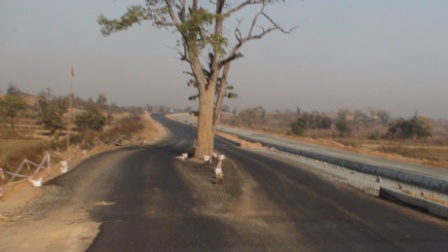
Or look here:


Bang in the middle of the highway, there is a tree. Why this particular tree near Ranchi on NH33 left untouched while expanding the road is a mystery. This is not the only tree blocking heavy duty trucks. There were many on this stretch.

Having crossed Ranchi, we halt at Hazaribagh outside a much larger dhaba - in front of the helipad (actually an empty ground, not the pucca airport which is nearby).


Tata trucks are returning to Jamshedpur after having unloaded axles for Ashok Leyland's new Rudrapur plant, explain Pandeyji. This is the first major halting centre after leaving Jamshedpur the previous night. A busy thoroughfare. Passenger vehicles, loaded with people inside and on top keep plying on this route. A lot of 'horses" (not to be mistaken for the four-legged animal, but the driving cabin of white Tata trucksi) are idling on the roadside while drivers tuck their rotis in. Road expansion is in full swing. Many decade-long trees have been cut and are carted in tempos to timber depots - auctioned by state government). Four-lane carriageway will be a reality in the next six months.

It is still cool in the cabin. Soon we will be touching NH 2 - a proper 4-lane carriageway linking Kolkota with New Delhi, reminds Pandeyji. Half an hour later, I begin to notice movement of trucks and car-carriers (mostly OSL Logistics) at a distance. We have neared Barhi, the border town or village on Jharkhand side and Rasoi Dhanonti toll gate is seen.

"Would you like to bathe?" asks Pandeyji. Why not? I respond positively.

"Wait," says he with a smile.

I begin to wait....

(To be continued)

Tuesday, 22 March 2011

20 Km/day will continue to be a dream


(PHOTO: NH33 in Jharkhand)

Highways Min struggles for possession of acquired land

Gunjan Pradhan Sinha

New Delhi : The ministry of road transport and highways, which has been successful in bringing land acquisition to levels needed to achieve 20-km-a-day target of road building, is, however, struggling to bring the acquired land under its possession and insulate itself from paying huge compensations to developers.

While, on paper, the ministry has managed to acquire 37,789 hectares of land for its national highways development programme (NHDP), land under its physical possession is rather low at 21,345 hectares.

The primary reason for the discrepancy is blamed on litigations and delays in shifting public utilities, which apparently is the responsibility of state governments. Last year, the ministry had decided to complete acquisition of at least 80 per cent of the land before awarding a project to ensure uninterrupted work. Under the land acquisition policy, the NHAI has to compensate the developer on a daily basis whenever it is unable to hand over the land for building a road.

In Goa, while land has been acquired under Section 3(D) of the National Highways Act 1956, the actual possession is nil. In Uttarakhand while land acquisition is 100 per cent, the actual possession is merely 40 hectares of the total 366 hectares. Himachal Pradesh, in particular, has been a tough state, where both acquisition and possession stand at zero against a total target of 78 hectares.

Other states where the NHDP is lagging on possession include Kerala, Bihar, Gujarat, Tamil Nadu, Karnataka and West Bengal. Also, states such as Bihar, Tamil Nadu, Gujarat, J&K, Delhi and UP are yet to sign the state support agreement (SSA) for land acquisition. The SSA is a reiteration of the constitutional responsibility of the state government and is legally tenable. In Bihar the NHAI managed to actually acquire 903 hectares of the intended 3,659 hectares. Land acquired in the state stands at 2,810 hectares. In Kerala high population density on either side of highways has stalled linear land acquisition. Of the targeted 1,361 hectares only 462 hectares has been acquired, of which roughly 200 hectares is under the Authority's possession. In Gujarat, huge tracts of lands were to be notified last year for acquisition but progress has been slow.

"If we actually have the acquired land under our possession, 20-km-a-day target is achievable," a senior government official associated with the process told The Indian Express. “Land acquisition has reached optimum levels to support our pipeline of projects approved for the NHDP," he said.

Courtesy: Indian Express